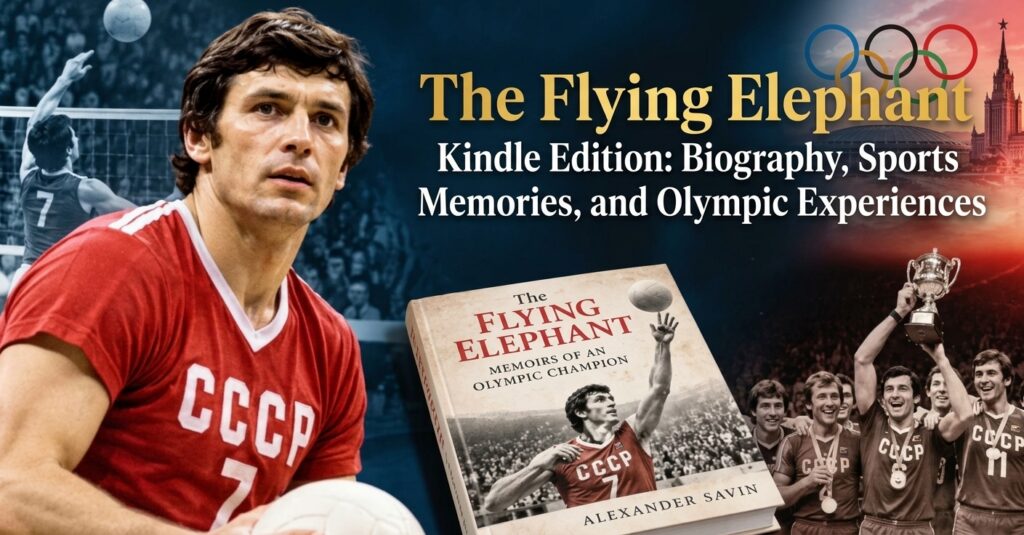

The Flying Elephant: Memoirs of an Olympic Champion is a sports memoir associated with Alexander Savin, the former Soviet volleyball player who won an Olympic silver medal in 1976 and an Olympic gold medal in 1980. His career places him among the notable athletes of Soviet-era international volleyball.
For readers interested in Olympic history, The Flying Elephant offers a starting point for exploring Savin’s sporting journey and the period in which he competed. Official sports records establish his Olympic results and international championship achievements, while the memoir’s reported publication information describes an English-language Kindle edition.
It is important to distinguish historical facts from book-specific claims. Savin’s medals and championship record are documented by Olympedia and the International Volleyball Hall of Fame. Details such as the Kindle edition’s page count and number of photographs should be checked against the current retailer listing before purchase.
Book Details at a Glance
The following table summarizes the available information about the English edition.
| Book detail | Reported information |
| Full title | The Flying Elephant: Memoirs of an Olympic Champion |
| Author | Alexander Savin |
| Main subject | Volleyball and Olympic sports history |
| Format | English-language Kindle edition |
| Reported publication date | October 26, 2025 |
| Reported print length | 514 pages |
| Reported photograph count | More than 240 |
| Reported Amazon identifier | B0FXVDWW16 |
The publication specifications above are reported by online pages associated with the book and its English edition. They should not all be treated as independently verified facts. Readers can check the current Amazon search listing for the reported identifier to confirm the edition, availability, and purchasing details.
The title and author connect the book to a real athlete with a verifiable international record. However, the existence of reliable records about Savin does not automatically verify every description of the memoir found online.
Who Is Alexander Savin? A Brief Biography
Aleksandr Borisovich Savin, also known in English as Alexander Savin, was born on July 1, 1957, in Taganrog, in the Rostov region of what is now Russia. Olympedia lists his height as 200 centimetres and records his association with CSKA Moscow.
Savin competed for the Soviet Union during a highly successful period for its men’s volleyball team. His career included Olympic appearances, World Championships, European Championships, and other international competitions.
His sporting record is independently documented by Olympedia, which lists two Olympic medals: one silver and one gold. The International Volleyball Hall of Fame also recognizes his contribution to the sport and inducted him in 2010.
These details provide a reliable foundation for understanding The Flying Elephant. Rather than relying on vague descriptions of sporting greatness, readers can examine Savin’s achievements through established competition records.
Alexander Savin’s Olympic Volleyball Career
Savin’s Olympic career is particularly notable because he experienced both defeat and victory in the men’s volleyball tournament. He won silver at Montreal in 1976 before becoming an Olympic champion in Moscow in 1980.
The 1976 Montreal Olympics and Silver Medal
At the 1976 Summer Olympics in Montreal, Savin represented the Soviet Union in men’s volleyball. The Soviet team advanced to the final after progressing through the tournament and defeating Cuba in the semifinals.
Poland won the final against the Soviet Union in five sets, leaving Savin and his teammates with the silver medal. The result is documented by the International Volleyball Hall of Fame and the official historical records compiled by Olympedia.
This result is important when considering The Flying Elephant because an athlete’s career is not defined by victories alone. Olympic competition also includes difficult defeats, preparation, and the experience of competing against other elite teams.
The verified historical point is straightforward: Savin’s Soviet team finished second in Montreal in 1976.
The 1980 Moscow Olympics and Gold Medal
Four years later, Savin returned to the Olympic stage at the 1980 Moscow Games. This time, the Soviet Union won the men’s volleyball tournament.
According to the International Volleyball Hall of Fame, the Soviet team defeated Bulgaria 3–1 in the gold-medal match. Savin played in all six of the Soviet team’s matches during the tournament, according to Hall’s biography.
The victory gave Savin his first Olympic gold medal and his second Olympic medal overall.
The progression from silver in 1976 to gold in 1980 is one of the clearest facts behind his sporting legacy. It also provides a useful historical framework for readers exploring The Flying Elephant Memoirs of an Olympic Champion.
His Achievements in International Volleyball
Savin’s career extended well beyond the Olympics.
Olympedia records the following major championship results:
| Competition | Years and results |
| Olympic Games | Silver in 1976; gold in 1980 |
| World Championships | Gold in 1978 and 1982; silver in 1986 |
| European Championships | Gold in 1975, 1977, 1979, 1981, 1983, and 1985 |
These results show that Savin competed successfully across several major international tournaments. They also place his career within a period when the Soviet Union was a leading force in men’s volleyball.
What Is The Flying Elephant: Memoirs of an Olympic Champion About?
The title identifies the work as a memoir connected with Savin’s life as an Olympic volleyball champion. A memoir differs from a conventional sports reference book because it presents events through the experiences and recollections of the person at its centre.
The available descriptions of The Flying Elephant associate it with Savin’s sporting life, Olympic experiences, and the people around him. Reports about the English translation also describe a project intended to preserve memories of teammates, coaches, and other figures connected with his career.
Readers should nevertheless be careful with detailed online summaries. Without a verified preview or direct examination of the full text, it is not possible to confirm every claimed anecdote, chapter, or personal revelation.
A responsible description is that the memoir concerns Savin and his sporting world. Its exact treatment of individual events should be assessed using the book itself rather than repeated promotional summaries.
The Memoir’s Historical Context: Soviet-Era Volleyball
Savin competed during a period when the Soviet Union was a major international volleyball power. Its national teams won Olympic and world-level titles, and the country’s sporting institutions supported athletes competing at the highest level.
The historical setting matters because international sport during the Soviet era existed within a different political, social, and organizational system from today’s professional sporting environment. Training structures, national-team selection, international travel, and the significance of representing one’s country all formed part of that broader context.
However, historical context should not be confused with evidence about an individual athlete’s private experiences. General facts about Soviet sports cannot establish what Savin personally thought or felt unless those views are documented in his own words or reliable accounts.
For readers exploring The Flying Elephant, the most useful approach is to read Savin’s memories alongside established volleyball history. Official competition records provide dates and results; a memoir can offer personal recollections that official records generally do not contain.
The People and Sporting Experiences Behind an Olympic Career
Team sports depend on more than individual ability. Players work with teammates, coaches, medical and support staff, and sporting organizations throughout their careers.
Savin’s Olympic history illustrates this team context. The International Volleyball Hall of Fame identifies Yuri Tchesnokov as the coach of the Soviet team at the 1976 Montreal Olympics. Its biography also records the Soviet team’s results and Savin’s participation in the 1976 and 1980 tournaments.
The Hall of Fame further notes the importance of the Soviet team’s playing relationships, including the connection between Savin and setter Vyacheslav Zaytsev.
These details are supported by the Hall’s historical account. More personal stories about relationships, private conversations, or behind-the-scenes events should be attributed to the memoir only when they can be checked in the text.
This distinction helps readers approach The Flying Elephant with realistic expectations. The documented team history is clear, while the details of personal recollections require direct evidence from the book.
The English Kindle Edition: Language, Format, and Publication Details
Online information describes an English Kindle edition of The Flying Elephant: Memoirs of an Olympic Champion. Accounts of the translation project identify Andrei Savine, Alfredo Cabero, and other collaborators as participants in preparing the English version.
The reported publication date is October 26, 2025, and the reported print length is 514 pages. These are edition-specific details, so they should be confirmed on the live retailer page. Kindle metadata, regional availability, and pricing can vary or change.
Readers should check the following before buying:
- The full title and author name.
- Whether the listing is the English-language Kindle edition.
- The publication and contributor information shown on the product page.
- The displayed price and availability in their own Amazon marketplace.
- Any device, app, or reading-format requirements.
The reported Amazon identifier is B0FXVDWW16. Use the Amazon search page for that identifier as a starting point, and confirm the product details shown by the retailer before making a purchase.
Photographs and Historical Material in the Book
Some online descriptions report that the English edition contains more than 240 photographs. This figure should be regarded as reported publication information until it can be confirmed directly from the retailer’s current listing or a reliable copy of the book.
If the edition does contain extensive photographic material, it could be useful to readers interested in the visual history of volleyball. Photographs may help document athletes, teams, sporting venues, uniforms, and other aspects of a particular period.
However, a photograph count alone does not establish the quality, historical significance, or provenance of the images. Those questions require access to the book and, where relevant, information about the photographs’ sources.
For readers considering The Flying Elephant, it is sensible to verify the image-related claims before treating the book as a comprehensive visual archive.
Read more: West Indies Cricket Team vs India National Cricket Team Timeline, Match History & Records
Who Should Consider Reading The Flying Elephant?
The memoir may appeal to several types of readers:
Volleyball fans: Readers interested in the history of the Soviet men’s team and its international achievements may find Savin’s career relevant.
Olympic history enthusiasts: Savin’s silver medal in 1976 and gold medal in 1980 provide a documented sporting story spanning two Olympic Games.
Athletes and coaches: Readers interested in elite competition may appreciate a first-person account of an athlete’s sporting life, while remembering that a memoir is one person’s perspective rather than a universal training guide.
Sports-history researchers: The book may be useful as a personal source when studying Soviet-era volleyball. Researchers should compare memoir statements with official results and other reliable historical material.
Readers interested in translated memoirs: The reported English edition may offer access to Savin’s story for readers who do not read Russian.
Whether The Flying Elephant is the right choice depends on the reader’s interests and on the edition’s verified contents. Checking a preview and the retailer’s description is the best way to decide.
What to Check Before Buying the Kindle Edition
Before purchasing The Flying Elephant, take a few minutes to verify the listing.
- Confirm the identity of the book. Make sure the title is The Flying Elephant Memoirs of an Olympic Champion and the author is Alexander Savin.
- Check the language. Confirm that the listing is for the English edition if that is the version you want.
- Review the edition details. Check the publication date, page-length information, and credited contributors shown by the retailer.
- Look for a preview. If available, use it to assess the writing, translation, layout, and actual contents.
- Verify image claims. If photographs are important to your decision, confirm what the product listing says and inspect sample pages where possible.
- Check the current price and availability. These can differ by marketplace and may change over time.
Do not rely exclusively on third-party websites that repeat the same specifications. A current retailer listing or direct inspection of the book is stronger evidence for edition-specific details.
Conclusion: Alexander Savin’s Legacy in Volleyball History
Alexander Savin’s place in volleyball history is supported by documented achievements. He won Olympic silver in Montreal in 1976, Olympic gold in Moscow in 1980, two World Championship gold medals, and six European Championship titles. The International Volleyball Hall of Fame inducted him in 2010.
The Flying Elephant Memoirs of an Olympic Champion is presented as a memoir connected with that sporting career, with an English Kindle edition reported by publication-related sources. Readers interested in the book should distinguish Savin’s verified achievements from edition details and descriptions that still require direct confirmation.
FAQs About The Flying Elephant
Who Wrote The Flying Elephant: Memoirs of an Olympic Champion?
The book is attributed to Alexander Savin, the former Soviet volleyball player and Olympic champion. The English edition is associated with a translation and editing project involving additional contributors.
What Sport Did Alexander Savin Play?
Alexander Savin played volleyball. He represented the Soviet Union in men’s volleyball at the 1976 and 1980 Summer Olympics.
Which Olympic Medals Did Alexander Savin Win?
Savin won silver at the 1976 Montreal Olympics and gold at the 1980 Moscow Olympics. Olympedia records one Olympic silver and one Olympic gold medal for him.
Is The Flying Elephant Available in English on Kindle?
Online publication information and accounts from people involved in the translation project report an English Kindle edition. Check the Amazon listing search to confirm current availability in your region.
How Can Readers Find the Correct Edition?
Search for the full title and Alexander Savin’s name, then compare the language, format, publication details, and identifier shown on the retailer page. The reported identifier is B0FXVDWW16, but readers should confirm the listing before purchasing.