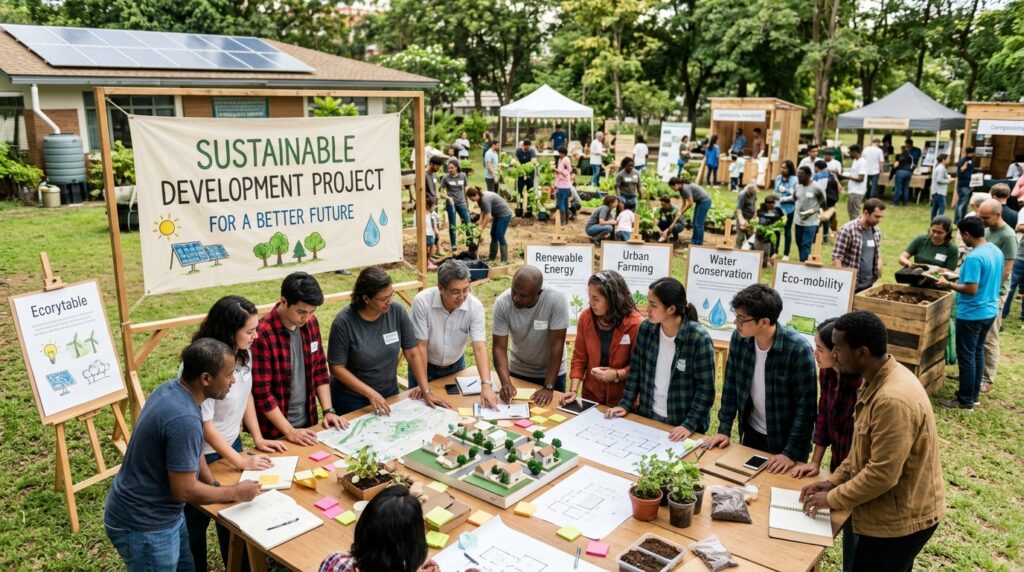

Sustainable development is about meeting today’s needs while protecting the ability of future generations to meet their own needs. It connects three major areas: economic development, social well-being, and environmental protection. The United Nations applies this approach through the 17 Sustainable Development Goals (SDGs), which address issues ranging from poverty and health to clean energy, responsible consumption, climate action, and biodiversity.
A sustainable development project turns these broad goals into practical action. It might involve installing renewable energy, improving access to safe water, restoring ecosystems, reducing waste, supporting sustainable farming, or creating environmental education programs.
The right project depends on the needs of a particular community, available resources, local environmental conditions, and the ability to maintain the results over time. Below are 20 practical ideas, followed by guidance on planning, measuring, and maintaining a project successfully.
What Is a Sustainable Development Project?
A sustainable development project is a planned activity that addresses a specific social, economic, or environmental need while considering its long-term effects.
For example, a community might develop a rainwater-harvesting system to improve water management, establish a composting program to handle organic waste, or restore a degraded habitat to support biodiversity.
A project is not automatically sustainable because it has an environmental purpose. It should also consider whether the project is affordable, socially appropriate, technically practical, and capable of continuing after the initial funding or implementation period.
Definition of Sustainable Development
The UN’s widely used definition describes sustainable development as development that meets present needs without compromising the ability of future generations to meet their own needs. The UN also emphasizes that economic growth, social inclusion, and environmental protection are interconnected.
What Makes a Project Sustainable?
A sustainable project generally has several characteristics:
- It responds to a clearly identified need.
- It uses resources responsibly.
- It considers environmental and social impacts.
- It has realistic goals and measurable indicators.
- Local stakeholders are involved where appropriate.
- Funding, skills, and infrastructure are available.
- There is a realistic plan for operation and maintenance.
These factors help turn an attractive idea into a project that can produce useful results over time.
The Three Dimensions of Sustainable Development
Sustainable development is commonly discussed through three connected dimensions:
Environmental sustainability focuses on natural resources, ecosystems, biodiversity, pollution, and environmental impacts.
Social sustainability considers people’s health, education, safety, inclusion, access to essential services, and quality of life.
Economic sustainability considers livelihoods, productivity, resource efficiency, affordability, and the financial ability to continue the project.
A strong sustainable development project considers these dimensions together rather than treating environmental protection as a separate issue.
How Sustainable Development Projects Support the UN SDGs
The 17 UN SDGs provide a global framework for sustainable development. A local project can contribute to one or several goals.
For example:
- A clean-water project can support SDG 6: Clean Water and Sanitation.
- A solar-energy initiative can support SDG 7: Affordable and Clean Energy.
- A sustainable farming project can support SDG 2: Zero Hunger.
- A recycling project can support SDG 12: Responsible Consumption and Production.
- A habitat-restoration project can contribute to SDG 15: Life on Land.
The SDGs are interconnected, so one well-designed project may support several areas at once.
How to Choose the Right Sustainable Development Project
Choosing a project should begin with the problem rather than the technology. A solution that works in one location may not be appropriate in another.
Identify a Local Need
Start by asking what problem needs attention.
Examples include:
- unreliable access to safe water,
- excessive waste,
- inefficient energy use,
- soil degradation,
- loss of vegetation,
- unsafe walking conditions,
- food waste, or
- limited environmental knowledge.
A simple needs assessment can include surveys, interviews, observations, existing records, and discussions with community members.
Evaluate Available Resources and Budget
Consider the resources available before selecting a project.
These may include:
- funding,
- land or buildings,
- equipment,
- local materials,
- technical skills,
- volunteers,
- partner organizations, and
- government or institutional support.
A smaller project that can be operated and maintained properly may be more practical than a larger project without adequate resources.
Set Clear and Measurable Goals
Good objectives should explain what the project intends to change and how the change will be measured. For example, instead of saying “reduce waste,” a project could measure the quantity of recyclable material separated from general waste over a defined period.
Consider Long-Term Maintenance
Maintenance should be considered before implementation begins.
Ask:
- Who will operate the project?
- Who will pay for repairs?
- What happens when equipment needs replacement?
- Who will collect monitoring data?
- What skills are required?
- How will community participation continue?
These questions are essential to the long-term success of a sustainable development project.
20 Sustainable Development Project Ideas
1. Solar Energy Projects for Homes and Communities
Solar photovoltaic (PV) systems convert sunlight into electricity and can be installed on suitable rooftops, buildings, or other locations.
A sustainable development project based on solar energy could provide electricity for a school, health facility, community building, or household where solar generation is technically and economically suitable.
The project should assess solar resources, electricity demand, installation costs, system components, safety, maintenance, and whether batteries are necessary.
2. Native Tree Planting and Forest Restoration Projects
Tree planting can contribute to ecosystem restoration when it is planned for an appropriate location and uses suitable species.
A restoration project can include:
- planting native or locally appropriate species,
- protecting young trees,
- controlling damaging pressures,
- monitoring survival,
- restoring degraded areas, and
- involving local communities.
Simply planting a large number of trees does not guarantee ecological success. Species selection, location, soil, water availability, biodiversity, and long-term management all matter.
3. Rainwater Harvesting and Water Conservation Systems
Rainwater harvesting collects rainfall, often from rooftops, for suitable uses.
A project could include:
- roof catchment systems,
- gutters,
- storage tanks,
- appropriate filtration,
- leak reduction, and
- water-efficient irrigation.
A complete sustainable development project should therefore consider local rainfall, storage requirements, water quality, treatment, maintenance, and regulations.
4. Community Recycling and Waste Separation Programs
Recycling projects work best when they are connected to a functioning collection and processing system.
A community program can introduce separate collections for materials that are actually recyclable in the local system.
Activities may include:
- household waste separation,
- clearly labeled collection points,
- collection schedules,
- waste audits,
- public education, and
- partnerships with recycling operators.
The project should measure actual material recovery rather than simply counting the number of collection bins installed.
5. Sustainable Agriculture and Soil Health Projects
Healthy soil supports food production and provides important ecosystem functions, including nutrient cycling, water regulation, and habitat for soil organisms.
FAO defines sustainable soil management as maintaining or improving soil services without significantly damaging soil functions or biodiversity.
A sustainable agriculture project could focus on:
- soil testing,
- erosion control,
- appropriate nutrient management,
- crop rotation,
- maintaining soil organic matter,
- efficient water management, and
- locally suitable farming practices.
The exact techniques should be selected according to soil type, climate, crops, and local farming conditions.
6. Safe Drinking Water and Sanitation Improvement Projects
Access to safe drinking water, sanitation, and hygiene is fundamental to health and well-being. WHO explains that water, sanitation, and hygiene services are important not only for health but also for dignity, education, livelihoods, and resilient communities.
A sustainable development project could improve:
- drinking-water systems,
- sanitation facilities,
- handwashing stations,
- wastewater management,
- water-quality monitoring, or
- hygiene practices.
Projects should include operation, maintenance, water-quality management, and community responsibilities—not just construction.
7. Sustainable School and Campus Initiatives
Schools and universities can use their campuses as practical environments for sustainability.
Possible projects include:
- energy audits,
- water conservation,
- waste separation,
- composting,
- school gardens,
- biodiversity areas,
- tree care, and
- sustainability education.
UNESCO’s Education for Sustainable Development framework emphasizes knowledge, skills, values, attitudes, and behaviors that support environmental, economic, and social sustainability.
8. Walking, Cycling, and Sustainable Transport Improvements
A sustainable transport project can improve conditions for walking, cycling, and public transportation.
Examples include:
- safer pedestrian crossings,
- improved sidewalks,
- bicycle parking,
- traffic-calming measures,
- better connections to public transport, and
- improved accessibility.
The design should be based on local travel patterns and safety conditions.
9. Energy-Efficient Building and Home Improvement Projects
Energy efficiency aims to provide the same useful services while using less energy.
A project can begin with an energy audit and identify opportunities such as:
- efficient lighting,
- insulation,
- improved ventilation,
- efficient appliances,
- shading, and
- better building controls.
The most appropriate improvements depend on the building’s design, climate, energy use, and costs.
10. Community Gardens and Local Food Production
Community gardens can make productive use of suitable land while providing opportunities for local food production and environmental education.
A project may combine:
- vegetable production,
- composting,
- soil improvement,
- water conservation,
- gardening education, and
- community participation.
Before starting, organizers should confirm land access, water availability, soil conditions, food-safety considerations, and responsibility for maintenance.
11. Single-Use Plastic Reduction Projects
Plastic reduction projects focus on preventing unnecessary plastic use before waste is created.
A school, office, market, or event can introduce:
- reusable products,
- refill systems,
- improved purchasing policies,
- better waste separation, and
- awareness campaigns.
The project should identify which plastic products create the largest local problems and choose alternatives that are practical and safe.
12. Sustainable Fisheries and Aquaculture Projects
Fishing and aquaculture projects need to consider both food production and aquatic ecosystems.
A sustainable fisheries project might support:
- responsible fishing practices,
- protection of important habitats,
- improved handling and storage,
- community-based resource management, or
- better monitoring of fisheries.
Aquaculture projects can consider water quality, disease management, feed, environmental impacts, biodiversity, and resource use.
13. Food Waste Reduction and Food Recovery Programs
Food waste can occur during production, storage, transportation, retail, food preparation, and consumption. A sustainable development project can begin with a food-waste audit to identify where and why food is being discarded.
Possible actions include:
- improving purchasing,
- better storage,
- portion management,
- using suitable surplus food,
- donating safe surplus where appropriate, and
- composting unavoidable organic waste.
Food safety should always be considered when recovering or redistributing food.
14. Urban Greening and Green Roof Projects
Urban greening projects can include:
- street trees,
- pocket parks,
- community gardens,
- planted public spaces, and
- green roofs.
These projects can support biodiversity and improve the quality of urban environments. Vegetation can also interact with stormwater, temperature, and public-space conditions.
15. Sustainable Livelihood and Green Skills Training Projects
A green-skills project can provide training in areas such as:
- renewable-energy installation and maintenance,
- sustainable agriculture,
- repair and reuse,
- recycling,
- energy efficiency,
- environmental monitoring, or
- ecosystem restoration.
Training should be connected to genuine local or regional opportunities. A course alone does not guarantee employment, so projects should consider employer needs, certification, equipment, and practical experience.
16. Biodiversity Conservation and Habitat Restoration Projects
Biodiversity projects can protect or restore forests, wetlands, grasslands, riversides, coastal areas, and other habitats.
Activities may include:
- restoring native vegetation,
- controlling invasive species,
- protecting important habitats,
- monitoring species, and
- reducing pressures on ecosystems.
FAO highlights the importance of soil biodiversity for functions such as nutrient cycling, soil structure, water regulation, and plant health.
17. Community Composting and Organic Waste Management
Composting turns suitable organic materials into a more stable material that can be used as a soil amendment.
A community composting project should establish:
- accepted materials,
- collection procedures,
- contamination controls,
- compost-management practices,
- odor and pest controls, and
- appropriate uses for finished compost.
This can connect waste reduction with community gardening and soil management.
18. Wetland and Coastal Ecosystem Restoration Projects
Wetlands and coastal ecosystems support biodiversity and provide important ecosystem functions.
A restoration project may involve:
- protecting remaining natural areas,
- restoring native vegetation,
- improving water conditions,
- reducing pollution,
- removing damaging pressures, or
- restoring natural ecological processes where appropriate.
UNEP identifies ecosystem restoration as a way to help degraded ecosystems recover while conserving healthy ecosystems.
19. Environmental Education and Community Awareness Programs
Environmental education can help people understand sustainability issues and develop practical skills.
A project might organize:
- school lessons,
- community workshops,
- demonstrations,
- waste audits,
- tree-care activities,
- water-saving campaigns, or
- citizen-monitoring programs.
UNESCO explains that Education for Sustainable Development aims to help people develop the knowledge, skills, values, attitudes, and behaviors needed for sustainable development.
20. Sustainable Wastewater Treatment and Reuse Projects
Wastewater treatment can reduce pollution and make treated water suitable for specific forms of reuse when health and regulatory requirements are met.
A project must consider:
- wastewater characteristics,
- treatment technology,
- water-quality requirements,
- health risks,
- environmental impacts,
- local regulations, and
- long-term operation and maintenance.
Reuse should never be treated as automatically safe simply because wastewater has passed through a treatment system.
Benefits of Sustainable Development Projects
Depending on their design, projects can help:
- reduce resource consumption,
- improve waste management,
- protect biodiversity,
- conserve water,
- improve soil management,
- increase renewable-energy use, or
- restore degraded ecosystems.
The specific benefit should be measured using appropriate environmental indicators.
Social and Community Benefits
A sustainable development project can also improve access to services, learning opportunities, public spaces, environmental information, and community participation.
For example, WHO identifies safe WASH services as important for health, dignity, education, livelihoods, and community resilience.
Economic Benefits
Some sustainability projects can reduce resource costs or support livelihoods. Energy-efficiency projects may reduce energy consumption, while sustainable agriculture or green-skills programs may support productive activities.
However, economic outcomes vary by location and project design. Financial benefits should therefore be calculated rather than assumed.
Long-Term Benefits for Future Generations
Long-term thinking is at the heart of sustainable development. A project should ask not only, “Does this solve today’s problem?” but also, “What environmental, social, and financial effects could this create in the future?”
How to Plan and Implement a Sustainable Development Project
Conduct a Needs Assessment
Gather information about the problem, affected groups, existing infrastructure, environmental conditions, and available resources. Use local evidence wherever possible.
Define Objectives and Scope
Set measurable objectives and clearly define the project’s boundaries. For example, specify the target location, beneficiaries, activities, timeline, and expected results.
Prepare a Budget and Timeline
Include both initial costs and long-term costs. Important expenses can include equipment, labor, training, monitoring, repairs, replacement parts, transportation, and administration.
Involve Stakeholders and Local Communities
People affected by the project should have appropriate opportunities to participate in planning and implementation. Relevant stakeholders may include residents, schools, businesses, local authorities, technical experts, NGOs, and service providers.
Monitor Progress and Measure Results
Select indicators before implementation begins.
Depending on the project, indicators might include:
- energy consumption,
- water use,
- waste recovered,
- tree survival,
- area restored,
- participation,
- training completion, or
- operating costs.
Plan for Long-Term Maintenance
A project should have clear responsibility for operation and maintenance. Without this, infrastructure and equipment can deteriorate even when the original project was well designed.
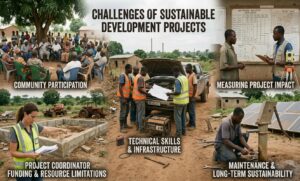
Challenges of Sustainable Development Projects
Funding and Resource Limitations
Limited funding can affect equipment, staffing, training, monitoring, and maintenance. Project planners should prioritize essential activities and develop realistic budgets.
Technical Skills and Infrastructure
Some projects require specialized equipment or expertise. Training local personnel can improve the ability to operate and maintain systems after implementation.
Community Participation
A project may struggle when local users are excluded from decisions that affect them. Participation should be meaningful and appropriate to the project’s context.
Maintenance and Long-Term Sustainability
Maintenance costs and responsibilities should be identified before implementation. A project that depends entirely on short-term external support may face difficulties after the initial funding ends.
Measuring Project Impact
Some environmental and social changes take time to become visible. Reliable monitoring therefore requires appropriate indicators, consistent data collection, and realistic expectations about when results should appear.
Read Also: TechyHitTools org Review: Features, Benefits, Safety, and Important Details
How to Measure the Success of a Sustainable Development Project
Possible indicators include:
- energy consumption,
- water consumption,
- waste generation,
- recycling or recovery rates,
- habitat area restored,
- tree survival rates,
- soil indicators, or
- biodiversity observations.
The appropriate indicator depends on the project’s objective.
Social Indicators
Social measures can include participation levels, access to services, training completion, user feedback, or other outcomes directly related to the project.
Economic Indicators
Economic monitoring can include:
- operating costs,
- maintenance costs,
- resource savings,
- revenue,
- income opportunities, or
- financial sustainability.
Monitoring and Continuous Improvement
Monitoring should continue throughout the project. If results differ from expectations, the project team can investigate why and adjust activities where appropriate. This creates a cycle of planning, implementation, measurement, learning, and improvement.
Final Verdict
A sustainable development project can begin with a small local problem and still contribute to broader sustainability goals. Solar energy, tree restoration, rainwater harvesting, recycling, sustainable farming, safe water, sustainable transport, biodiversity conservation, and environmental education are just some of the practical possibilities.
The most important part is not simply choosing a popular project idea. It is understanding the local need, using reliable evidence, setting measurable objectives, involving relevant stakeholders, and planning for long-term maintenance.
The 20 ideas in this guide can be adapted to different communities, schools, organizations, and development programs. Their results will depend on local conditions and project quality.