
Digital learning has changed the way students find information, prepare for examinations, and organize their study activities. Instead of depending on a single textbook or classroom resource, learners can now use online articles, study guides, tutorials, practice materials, digital tools, and educational platforms to supplement their learning.
Tendereducation com is associated with an education-focused website and content covering topics related to study guides, learning resources, exam preparation, and educational tools. These are broad areas that can be useful to students, but website-specific information should always be checked against the site’s current pages and other reliable sources before being treated as authoritative.
What Is Tendereducation com?
Tendereducation.com refers to the website domain tendereducation.com. The site’s subject matter is associated with educational information, particularly content relating to studying, learning resources, examination preparation, and educational technology.
It is important to distinguish between an educational website and an official educational authority. A website may publish useful information about education without being a school, university, examination board, government department, or accredited academic institution.
For this reason, students should evaluate individual articles and claims carefully. Information concerning examination dates, syllabuses, academic requirements, qualifications, or institutional policies should be confirmed through the relevant official organization.
What Topics Does Tendereducation.com Cover?
The material associated with Tendereducation com centers on several broad areas of learning:
- Study guides
- Learning resources
- Exam tips and preparation
- Educational tools
These topics reflect common needs among modern learners. Students may need a structured guide when beginning a subject, additional resources when a concept is difficult, preparation strategies before an examination, or digital tools for managing notes and assignments.
Why Are These Educational Topics Important?
Each category addresses a different part of the learning process. A study guide can organize information into manageable sections. Learning resources can provide alternative explanations or practice. Exam tips can help students plan their preparation, while educational tools can assist with organization and productivity.
Rather than using every available resource, students should select materials based on what they are actually trying to learn.
Tendereducation com Study Guides and Their Importance
Study guides can help learners organize information and review important concepts. They may be particularly useful when a subject contains a large amount of material.
Free Study Guides
Free study guides can give students access to supplementary educational information without requiring an additional purchase.
However, students should not assume that a free resource is automatically reliable. The content should be checked for accuracy, relevance, and consistency with the student’s syllabus or primary course materials.
For important subjects, a free online guide is generally best used as a supplement rather than the only source of information.
Step-by-Step Study Guides
A step-by-step study guide divides a learning task into smaller stages. This approach can be helpful for beginners because it provides a logical sequence instead of presenting a large amount of information at once.
For example, a learner might first study basic terminology, then review fundamental concepts, complete examples, and finally attempt practice questions. Breaking a difficult subject into smaller tasks can make the learning process easier to organize.
Subject-Wise Study Guides
Different academic subjects require different types of preparation. A mathematics learner may need worked examples and problem-solving practice. A history student may need to understand chronology, causes, consequences, and key events. A language learner may need vocabulary, grammar, reading, writing, listening, or speaking practice.
Subject-specific study guides can therefore be useful when their content matches the actual requirements of a course or examination.
Study Guides for Students
Students can use study guides as supplementary material alongside textbooks, classroom lessons, assignments, and teacher-provided resources. A guide may help organize revision or highlight areas that require additional attention.
However, learners should compare supplementary material with their official course requirements. A guide should not replace instructions provided by the institution responsible for the course or examination.
Beginner Study Guides
Beginners often need foundational information before moving to advanced material. A beginner-oriented guide can introduce basic terminology and concepts and provide a structured starting point.
As the learner progresses, more detailed textbooks, academic resources, practical exercises, or instructor guidance may become necessary.
Tendereducation com Learning Resources for Students
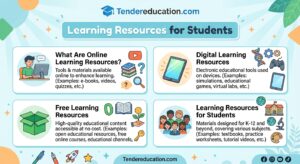
Learning resources include materials that help students acquire, review, or practice knowledge and skills. They can be physical or digital, but online learning has made digital resources particularly accessible.
What Are Online Learning Resources?
Online learning resources are educational materials available through internet-connected devices.
Common examples include:
- Online courses
- Tutorials
- Educational websites
- Digital books
- Video lessons
- Podcasts
- Webinars
- Practice quizzes
- Interactive exercises
Digital Learning Resources
Digital learning resources can include electronic books, websites, videos, online lessons, interactive exercises, and digital reference materials.
Their main advantage is accessibility. Learners can often access materials from a computer, tablet, or smartphone. However, digital availability does not guarantee educational quality. Students should evaluate the source and compare important information with reliable references.
Free Learning Resources
Free resources can make learning materials available to people who may not want or be able to purchase additional educational products.
Many reputable organizations provide free educational content, but the quality of free material varies. Before using a resource, students should consider its author, publisher, date, references, and relevance to the subject.
Learning Resources for Students
Students should select resources according to their learning objectives. For example, a student who needs to understand a difficult concept may need an explanatory lesson, while someone preparing for an examination may benefit more from practice questions and revision materials.
Exam Tips and Preparation Strategies
Examination preparation requires planning, review, practice, and an understanding of what the assessment requires.
Effective Exam Preparation Tips
A useful preparation process can begin by reviewing the syllabus or examination requirements.
Students can then:
- Identify the topics they need to study.
- Divide large topics into smaller sections.
- Create a realistic study schedule.
- Review material regularly.
- Practice answering questions.
- Identify weak areas.
- Revise those areas before the examination.
The exact strategy should be adapted to the subject and examination format.
Time Management for Exams
Time management helps learners make better use of the preparation period. A student can estimate the amount of available time and divide it between different subjects or topics.
It is important to keep the schedule realistic. A plan that leaves no time for breaks, meals, sleep, or unexpected responsibilities may be difficult to maintain.
Smart Study Strategies
Studying effectively is not simply about spending more hours reading. Active learning techniques can encourage students to retrieve information, explain concepts, solve problems, and test their understanding.
For example, after reading a chapter, a student can close the book and write down the main ideas from memory. Practice questions can then be used to identify areas that need more attention.
Last-Minute Exam Preparation
Sometimes students reach the final days before an examination with material still to review. In this situation, prioritization is important. Learners can focus on essential concepts, frequently practiced question types, and areas where they have the greatest difficulty. Last-minute revision can support preparation, but it is not a substitute for consistent study throughout a course.
How to Create an Exam Study Plan
A simple exam study plan can include:
- Examination dates
- Subjects
- Individual topics
- Available study periods
- Practice sessions
- Revision periods
- Breaks and rest
Students should review their progress regularly and adjust the schedule when necessary.
Tendereducation com Educational Tools for Learning
Digital educational tools can support different parts of a student’s routine. Some tools focus on learning itself, while others help with organization, communication, research, or productivity.
Digital Educational Tools
Common categories of educational tools include:
- Learning management systems
- Digital note-taking applications
- Flashcard tools
- Research resources
- Collaboration platforms
- Mind-mapping tools
- Calendar applications
- Task-management software
The best tool depends on the task.
Study Tools for Students
Study tools should be selected according to a specific need.
For example:
- Note-taking tools can organize information.
- Calendar tools can track important dates.
- Task managers can organize assignments.
- Flashcards can support recall practice.
- Mind maps can visually organize connected ideas.
Free Educational Tools
Some educational platforms provide free access to at least part of their services. Examples of widely recognized educational platforms include Khan Academy, Google Classroom, and Duolingo. Their features, availability, and pricing can change, so users should check the provider’s current information before depending on a particular service. A free tool should also be evaluated for suitability, privacy, usability, and educational value.
Online Educational Tools
Online educational tools can make learning activities accessible through internet-connected devices. They can support learning at home, school, university, or other suitable locations.
Students should nevertheless consider internet requirements, privacy, account security, distractions, and the quality of the information provided.
How to Choose the Right Learning Resources
Finding an educational resource is easy. Finding the right one requires more careful evaluation.
Consider Your Learning Goal
Start by asking what you need to accomplish. Do you want to understand a concept, prepare for an exam, practice a skill, review previous material, or organize your study routine? A clear objective makes it easier to identify useful resources.
Match Resources to Your Subject
The material should be relevant to the subject and academic level. Students should compare supplementary resources with their syllabus and primary course materials whenever possible.
Check the Source
Consider who created the material and whether the source has relevant expertise. For academic topics, identifiable authors, institutions, references, and supporting evidence can provide useful signals of credibility.
Check the Date
Some information changes over time. This is particularly important for examination rules, software, educational policies, course requirements, and other time-sensitive subjects.
Compare Important Information
If an unfamiliar website provides important academic information, verify it through an authoritative source. For example, official examination requirements should be checked with the relevant examination authority rather than relying exclusively on a third-party article.
How to Use Study Guides Effectively
Tendereducation com a study guide becomes more useful when students actively engage with the material.
Turn Information Into Questions
Students can convert headings and key concepts into questions. Instead of simply reading a definition, they can ask themselves to explain it without looking at the answer.
Use Active Recall
Active recall involves attempting to retrieve information from memory. After studying a topic, students can close their notes and explain the main ideas from memory. This can reveal gaps in understanding.
Practice With Questions
Practice questions can show whether a student can apply knowledge rather than simply recognize it. Wrong answers should be reviewed carefully. Understanding why an answer was wrong can help prevent the same mistake later.
Review Difficult Topics
Students should identify topics that repeatedly cause difficulty. Those areas can receive additional practice or explanation before moving on.
How to Use Digital Learning Tools Responsibly
Technology can support learning, but it should remain a means rather than the goal.
Avoid Tool Overload
Students do not need a separate application for every study activity. Using too many platforms can create unnecessary complexity and distractions.
Protect Your Accounts
Students should use strong, unique passwords where appropriate and review the privacy settings of online services. Personal information should not be provided unnecessarily.
Verify AI and Online Information
Digital tools can produce useful information, but students should not automatically assume that every generated or published answer is correct.
Important academic information should be checked against textbooks, instructors, official sources, or other authoritative references.
Benefits of Online Learning Resources
Tendereducation com online resources can provide several practical advantages.
Flexible Access
Digital materials can often be accessed outside traditional classroom hours. This can help learners who need to study around other responsibilities.
Variety of Formats
Online education can provide written material, video, audio, interactive exercises, quizzes, and other formats. Different formats can be combined according to the learner’s needs.
Support for Independent Learning
Online resources can help students explore subjects independently. However, self-directed learning requires discipline, planning, and the ability to evaluate information.
Convenient Revision
Digital resources can make it easier to return to previously studied material. Students can organize bookmarks, digital notes, saved documents, and revision materials according to their own workflow.
Read more: Throw Pillows: Ultimate Guide to Choosing, Styling & Decorating Your Home
Tendereducation com and Responsible Online Learning
When researching Tendereducation com, students should distinguish between general educational advice and verified information about the website itself.
A website’s name, design, or educational subject matter does not by itself establish that it is an official or academically accredited source.
Verify Website-Specific Claims
Claims about ownership, accreditation, authorship, educational partnerships, services, or official status should be confirmed using reliable evidence.
Use Authoritative Sources for High-Stakes Information
If information concerns an examination, qualification, admission requirement, school policy, or government regulation, students should consult the relevant official organization.
Third-party educational websites can provide useful background information, but they should not automatically override official instructions.
Evaluate Every Resource on Its Own Merit
Even within the same website, individual articles may vary in quality. Students should evaluate each resource based on accuracy, relevance, evidence, date, and usefulness.
Final Thoughts
Tendereducation com is associated with educational topics such as study guides, learning resources, exam preparation, and educational tools. These subjects are relevant to modern students because they address several common parts of the learning process.
Study guides can help organize information. Online learning resources can provide additional explanations and practice. Exam strategies can help learners plan their preparation, while digital tools can support organization and productivity.
At the same time, students should approach online educational information critically. Not every website is an official academic authority, and not every online claim is automatically accurate.
FAQs About Tendereducation com
What is Tendereducation com?
Tendereducation.com refers to the website domain tendereducation.com and is associated with educational and study-related content. Readers should verify current website information directly rather than assuming that every online claim is authoritative.
What educational topics are associated with Tendereducation.com?
The material described for Tendereducation com focuses broadly on study guides, learning resources, exam tips, and educational tools. The current status of individual categories or articles should be confirmed on the website itself.
Can students use Tendereducation.com for exam preparation?
Students may use educational websites as supplementary resources, but examination requirements should always be checked against official course or examination sources.
What are educational tools?
Educational tools are applications, platforms, or resources that can support activities such as learning, revision, note-taking, research, collaboration, organization, and productivity.
How should students evaluate online learning resources?
Students should consider the source, author, date, evidence, relevance, and consistency with authoritative information before relying on an online educational resource.